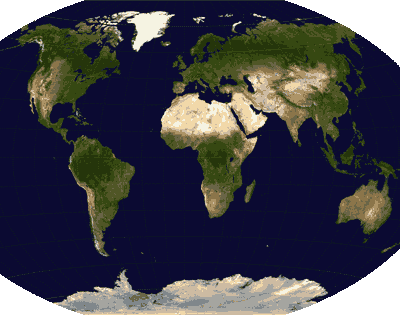
This map shows the size of Wallis and Futuna in relation to Tonga.
Show Wallis and Futuna on the map
Tonga |
to |
Wallis and Futuna |
The number of deaths of infants under one year old in a given year per 1,000 live births in Wallis and Futuna is 4.74 while in Tonga it is 11.28.
This entry gives the number of deaths of infants under one year old in a given year per 1,000 live births in the same year; included is the total death rate, and deaths by sex, male and female. This rate is often used as an indicator of the level of health in a country.
Source: CIA World Factbook
The life expectancy at birth in Wallis and Futuna is 78.83 while in Tonga it is 71.03.
This entry contains the average number of years to be lived by a group of people born in the same year, if mortality at each age remains constant in the future. The entry includes total population as well as the male and female components. Life expectancy at birth is also a measure of overall quality of life in a country and summarizes the mortality at all ages. It can also be thought of as indicating the potential return on investment in human capital and is necessary for the calculation of various actuarial measures.
Source: CIA World Factbook
The GDP per capita in Wallis and Futuna is $3,800 while in Tonga it is $4,600
This entry shows GDP on a purchasing power parity basis divided by population as of 1 July for the same year. A nation's GDP at purchasing power parity (PPP) exchange rates is the sum value of all goods and services produced in the country valued at prices prevailing in the United States. This is the measure most economists prefer when looking at per-capita welfare and when comparing living conditions or use of resources across countries. The measure is difficult to compute, as a US dollar value has to be assigned to all goods and services in the country regardless of whether these goods and services have a direct equivalent in the United States (for example, the value of an ox-cart or non-US military equipment); as a result, PPP estimates for some countries are based on a small and sometimes different set of goods and services. In addition, many countries do not formally participate in the World Bank's PPP project that calculates these measures, so the resulting GDP estimates for these countries may lack precision. For many developing countries, PPP-based GDP measures are multiples of the official exchange rate (OER) measure. The differences between the OER- and PPP-denominated GDP values for most of the wealthy industrialized countries are generally much smaller.
Source: CIA World Factbook
Wallis and Futuna has an unemployment rate of 15.20% while Tonga has 13.00%
This entry contains the percent of the labor force that is without jobs.
Source: CIA World Factbook
With its 15,343 people Wallis and Futuna is the 216th largest country in the world by population. It is the 217th largest country by area with 142 square kilometers. The Futuna island group was discovered by the Dutch in 1616 and Wallis by the British in 1767, but it was the French who declared a protectorate over the islands in 1842. In 1959, the inhabitants of the islands voted to become a French overseas territory.
Check out the recommended reading list below for great sources of information on Wallis and Futuna.
The Wallis & Futuna Travel Journal
Younghusband World Travel Journals
Wallis & Futuna Investment & Business Guide
Ibp Usa
Wallis and Futuna: A Spy Guide (World Country Study Guide Library)
Ibp Usa
Compact Atlas of the World (Compact World Atlas)
DK Publishing
Wallis and Futuna: Guide to the Country
International Country Guides
Concise World Atlas (Sixth Edition)
DK Publishing
New Caledonia and dependencies and Wallis and Futuna : official standard names approved by the United States Board on Geographic Names / prepared by the Defense Mapping Agency Topographic Center
United States. Defense Mapping Agency. Topographic Center.
Lonely Planet South Pacific (Multi Country Guide)
Celeste Brash
South Pacific (Multi Country Travel Guide)
Rowan Mckinnon
Up Pohnpei
Paul Watson