Compare
Turks and Caicos Islands
to
Malaysiato
MalaysiaMalaysia has an unemployment rate of 2.90% while Turks and Caicos Islands has 10.00%
This entry contains the percent of the labor force that is without jobs.
Source:
CIA World Factbook
The life expectancy at birth in Malaysia is 74.52 while in Turks and Caicos Islands it is 79.55.
This entry contains the average number of years to be lived by a group of people born in the same year, if mortality at each age remains constant in the future. The entry includes total population as well as the male and female components. Life expectancy at birth is also a measure of overall quality of life in a country and summarizes the mortality at all ages. It can also be thought of as indicating the potential return on investment in human capital and is necessary for the calculation of various actuarial measures.
Source:
CIA World Factbook
The GDP per capita in Malaysia is $17,500 while in Turks and Caicos Islands it is $29,100
This entry shows GDP on a purchasing power parity basis divided by population as of 1 July for the same year. A nation's GDP at purchasing power parity (PPP) exchange rates is the sum value of all goods and services produced in the country valued at prices prevailing in the United States. This is the measure most economists prefer when looking at per-capita welfare and when comparing living conditions or use of resources across countries. The measure is difficult to compute, as a US dollar value has to be assigned to all goods and services in the country regardless of whether these goods and services have a direct equivalent in the United States (for example, the value of an ox-cart or non-US military equipment); as a result, PPP estimates for some countries are based on a small and sometimes different set of goods and services. In addition, many countries do not formally participate in the World Bank's PPP project that calculates these measures, so the resulting GDP estimates for these countries may lack precision. For many developing countries, PPP-based GDP measures are multiples of the official exchange rate (OER) measure. The differences between the OER- and PPP-denominated GDP values for most of the wealthy industrialized countries are generally much smaller.
Source:
CIA World Factbook
1.90 in every 100,000 people are murdered annually in Malaysia compared to 6.60 in Turks and Caicos Islands
This entry contains the number of victims of an unlawful death purposefully inflicted on a person by another person. Data is originally sourced from either criminal justice or public health systems.
Source:
United Nations Office on Drugs and Crime
The number of deaths of infants under one year old in a given year per 1,000 live births in Malaysia is 13.69 while in Turks and Caicos Islands it is 10.97.
This entry gives the number of deaths of infants under one year old in a given year per 1,000 live births in the same year; included is the total death rate, and deaths by sex, male and female. This rate is often used as an indicator of the level of health in a country.
Source:
CIA World Factbook
Turks and Caicos Islands consumes 0.8568 gallons of oil per day per capita while Malaysia consumes 0.7602
This entry is the total oil consumed in gallons per day (gal/day) divided by the population. The discrepancy between the amount of oil produced and/or imported and the amount consumed and/or exported is due to the omission of stock changes, refinery gains, and other complicating factors.
Source:
CIA World Factbook
The per capita consumption of electricity in Turks and Caicos Islands is 3,790kWh while in Malaysia it is 3,724kWh
This entry consists of total electricity generated annually plus imports and minus exports, expressed in kilowatt-hours. The discrepancy between the amount of electricity generated and/or imported and the amount consumed and/or exported is accounted for as loss in transmission and distribution.
Source:
CIA World Factbook
The annual number of births per 1,000 people in Malaysia is 20.06 while in Turks and Caicos Islands it is 16.61.
This entry gives the average annual number of births during a year per 1,000 persons in the population at midyear; also known as crude birth rate. The birth rate is usually the dominant factor in determining the rate of population growth. It depends on both the level of fertility and the age structure of the population.
Source:
CIA World Factbook
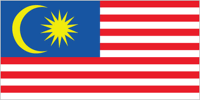 With its 30,073,353 people, Malaysia is the
43rd largest country in the world by
population. It is the 67th largest country in the
world by area with 329,847 square kilometers.
With its 30,073,353 people, Malaysia is the
43rd largest country in the world by
population. It is the 67th largest country in the
world by area with 329,847 square kilometers.
During the late 18th and 19th centuries, Great Britain established colonies and protectorates in the area of current Malaysia; these were occupied by Japan from 1942 to 1945. In 1948, the British-ruled territories on the Malay Peninsula except Singapore formed the Federation of Malaya, which became independent in 1957. Malaysia was formed in 1963 when the former British colonies of Singapore, as well as Sabah and Sarawak on the northern coast of Borneo, joined the Federation. The first several years of the country's independence were marred by a communist insurgency, Indonesian confrontation with Malaysia, Philippine claims to Sabah, and Singapore's withdrawal in 1965. During the 22-year term of Prime Minister MAHATHIR bin Mohamad (1981-2003), Malaysia was successful in diversifying its economy from dependence on exports of raw materials to the development of manufacturing, services, and tourism. Prime Minister Mohamed NAJIB bin Abdul Razak (in office since April 2009) has continued these pro-business policies and has introduced some civil reforms.
Check out the recommended reading list below for great sources of information on Malaysia