Compare
San Marino
to
Tajikistanto
TajikistanThe life expectancy at birth in Tajikistan is 67.06 while in San Marino it is 83.18.
This entry contains the average number of years to be lived by a group of people born in the same year, if mortality at each age remains constant in the future. The entry includes total population as well as the male and female components. Life expectancy at birth is also a measure of overall quality of life in a country and summarizes the mortality at all ages. It can also be thought of as indicating the potential return on investment in human capital and is necessary for the calculation of various actuarial measures.
Source:
CIA World Factbook
The number of deaths of infants under one year old in a given year per 1,000 live births in Tajikistan is 35.03 while in San Marino it is 4.52.
This entry gives the number of deaths of infants under one year old in a given year per 1,000 live births in the same year; included is the total death rate, and deaths by sex, male and female. This rate is often used as an indicator of the level of health in a country.
Source:
CIA World Factbook
121 in every 100,000 people are currently imprisoned in Tajikistan compared to 6 in San Marino
This entry contains the number of people in penal institutions, including pre-trial detainees. Comparability is hampered by differences in local practice, including whether psychiatrically ill offenders are under the authority of the prison administration. People held in a form of custody not under the authority of a prison administration are not included in this figure.
Source:
International Centre for Prison Studies
Tajikistan has an unemployment rate of 2.50% while San Marino has 8.70%
This entry contains the percent of the labor force that is without jobs.
Source:
CIA World Factbook
Per capita public and private health expenditures combined in Tajikistan are $54.90 USD while San Marino spends $3,791.80 USD
This entry contains the per capita public and private health expenditure at purchase power parity using US Dollars. This figure combines government, personal, and employer spending on health care
Source:
World Health Organization
The annual number of births per 1,000 people in Tajikistan is 24.99 while in San Marino it is 8.70.
This entry gives the average annual number of births during a year per 1,000 persons in the population at midyear; also known as crude birth rate. The birth rate is usually the dominant factor in determining the rate of population growth. It depends on both the level of fertility and the age structure of the population.
Source:
CIA World Factbook
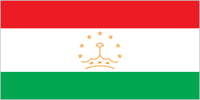 With its 8,051,512 people, Tajikistan is the
96th largest country in the world by
population. It is the 96th largest country in the
world by area with 143,100 square kilometers.
With its 8,051,512 people, Tajikistan is the
96th largest country in the world by
population. It is the 96th largest country in the
world by area with 143,100 square kilometers.
The Tajik people came under Russian rule in the 1860s and 1870s, but Russia's hold on Central Asia weakened following the Revolution of 1917. Bands of indigenous guerrillas (called "basmachi") fiercely contested Bolshevik control of the area, which was not fully reestablished until 1925. Tajikistan was first created as an autonomous republic within Uzbekistan in 1924, but the USSR designated Tajikistan a separate republic in 1929 and transferred to it much of present-day Sughd province. Ethnic Uzbeks form a substantial minority in Tajikistan. Tajikistan became independent in 1991 following the breakup of the Soviet Union, and experienced a civil war between regional factions from 1992 to 1997. Tajikistan endured several domestic security incidents during 2010-12, including armed conflict between government forces and local strongmen in the Rasht Valley and between government forces and criminal groups in Gorno-Badakhshan Autonomous Oblast. The country remains the poorest in the former Soviet sphere. Tajikistan became a member of the World Trade Organization in March 2013. However, its economy continues to face major challenges, including dependence on remittances from Tajikistanis working in Russia, pervasive corruption, and the major role narcotrafficking plays in the country's informal economy.
Check out the recommended reading list below for great sources of information on Tajikistan