Compare
Sweden
to
Moroccoto
MoroccoThe number of deaths of infants under one year old in a given year per 1,000 live births in Morocco is 24.52 while in Sweden it is 2.60.
This entry gives the number of deaths of infants under one year old in a given year per 1,000 live births in the same year; included is the total death rate, and deaths by sex, male and female. This rate is often used as an indicator of the level of health in a country.
Source:
CIA World Factbook
The life expectancy at birth in Morocco is 76.51 while in Sweden it is 81.89.
This entry contains the average number of years to be lived by a group of people born in the same year, if mortality at each age remains constant in the future. The entry includes total population as well as the male and female components. Life expectancy at birth is also a measure of overall quality of life in a country and summarizes the mortality at all ages. It can also be thought of as indicating the potential return on investment in human capital and is necessary for the calculation of various actuarial measures.
Source:
CIA World Factbook
221 in every 100,000 people are currently imprisoned in Morocco compared to 57 in Sweden
This entry contains the number of people in penal institutions, including pre-trial detainees. Comparability is hampered by differences in local practice, including whether psychiatrically ill offenders are under the authority of the prison administration. People held in a form of custody not under the authority of a prison administration are not included in this figure.
Source:
International Centre for Prison Studies
The GDP per capita in Morocco is $5,500 while in Sweden it is $40,900
This entry shows GDP on a purchasing power parity basis divided by population as of 1 July for the same year. A nation's GDP at purchasing power parity (PPP) exchange rates is the sum value of all goods and services produced in the country valued at prices prevailing in the United States. This is the measure most economists prefer when looking at per-capita welfare and when comparing living conditions or use of resources across countries. The measure is difficult to compute, as a US dollar value has to be assigned to all goods and services in the country regardless of whether these goods and services have a direct equivalent in the United States (for example, the value of an ox-cart or non-US military equipment); as a result, PPP estimates for some countries are based on a small and sometimes different set of goods and services. In addition, many countries do not formally participate in the World Bank's PPP project that calculates these measures, so the resulting GDP estimates for these countries may lack precision. For many developing countries, PPP-based GDP measures are multiples of the official exchange rate (OER) measure. The differences between the OER- and PPP-denominated GDP values for most of the wealthy industrialized countries are generally much smaller.
Source:
CIA World Factbook
Morocco has an unemployment rate of 9.70% while Sweden has 7.90%
This entry contains the percent of the labor force that is without jobs.
Source:
CIA World Factbook
Per capita public and private health expenditures combined in Morocco are $190.30 USD while Sweden spends $5,319.40 USD
This entry contains the per capita public and private health expenditure at purchase power parity using US Dollars. This figure combines government, personal, and employer spending on health care
Source:
World Health Organization
The per capita consumption of electricity in Sweden is 13,986kWh while in Morocco it is 715kWh
This entry consists of total electricity generated annually plus imports and minus exports, expressed in kilowatt-hours. The discrepancy between the amount of electricity generated and/or imported and the amount consumed and/or exported is accounted for as loss in transmission and distribution.
Source:
CIA World Factbook
Sweden consumes 1.3650 gallons of oil per day per capita while Morocco consumes 0.2604
This entry is the total oil consumed in gallons per day (gal/day) divided by the population. The discrepancy between the amount of oil produced and/or imported and the amount consumed and/or exported is due to the omission of stock changes, refinery gains, and other complicating factors.
Source:
CIA World Factbook
The GINI index measures the degree of inequality in the distribution of family income. In Morocco it is 40.90 while in Sweden it is 23.00.
This index measures the degree of inequality in the distribution of family income in a country. The index is calculated from the Lorenz curve, in which cumulative family income is plotted against the number of families arranged from the poorest to the richest. The index is the ratio of (a) the area between a country's Lorenz curve and the 45 degree helping line to (b) the entire triangular area under the 45 degree line. The more nearly equal a country's income distribution, the closer its Lorenz curve to the 45 degree line and the lower its Gini index, e.g., a Scandinavian country with an index of 25. The more unequal a country's income distribution, the farther its Lorenz curve from the 45 degree line and the higher its Gini index, e.g., a Sub-Saharan country with an index of 50. If income were distributed with perfect equality, the Lorenz curve would coincide with the 45 degree line and the index would be zero; if income were distributed with perfect inequality, the Lorenz curve would coincide with the horizontal axis and the right vertical axis and the index would be 100.
Source:
CIA World Factbook
1.30 in every 100,000 people are murdered annually in Morocco compared to 0.90 in Sweden
This entry contains the number of victims of an unlawful death purposefully inflicted on a person by another person. Data is originally sourced from either criminal justice or public health systems.
Source:
United Nations Office on Drugs and Crime
The percentage of adults living with HIV/AIDS in Morocco is 0.10% while in Sweden it is 0.10%. 1,200 people in Morocco and 100 people in Sweden die from AIDS each year.
This entry gives an estimate of the percentage of adults (aged 15-49) living with HIV/AIDS. The adult prevalence rate is calculated by dividing the estimated number of adults living with HIV/AIDS at yearend by the total adult population at yearend.
Source:
CIA World Factbook
The annual number of births per 1,000 people in Morocco is 18.47 while in Sweden it is 11.92.
This entry gives the average annual number of births during a year per 1,000 persons in the population at midyear; also known as crude birth rate. The birth rate is usually the dominant factor in determining the rate of population growth. It depends on both the level of fertility and the age structure of the population.
Source:
CIA World Factbook
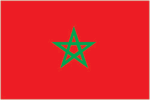 With its 32,987,206 people, Morocco is the
38th largest country in the world by
population. It is the 58th largest country in the
world by area with 446,550 square kilometers.
With its 32,987,206 people, Morocco is the
38th largest country in the world by
population. It is the 58th largest country in the
world by area with 446,550 square kilometers.
In 788, about a century after the Arab conquest of North Africa, a series of Moroccan Muslim dynasties began to rule in Morocco. In the 16th century, the Sa'adi monarchy, particularly under Ahmad al-MANSUR (1578-1603), repelled foreign invaders and inaugurated a golden age. The Alaouite Dynasty, to which the current Moroccan royal family belongs, dates from the 17th century. In 1860, Spain occupied northern Morocco and ushered in a half century of trade rivalry among European powers that saw Morocco's sovereignty steadily erode; in 1912, the French imposed a protectorate over the country. A protracted independence struggle with France ended successfully in 1956. The internationalized city of Tangier and most Spanish possessions were turned over to the new country that same year. Sultan MOHAMMED V, the current monarch's grandfather, organized the new state as a constitutional monarchy and in 1957 assumed the title of king. Although Morocco is not the UN-recognized Administering Power for the Western Sahara, it exercises de facto administrative control over 80% of the territory. The UN since 1991 has monitored a ceasefire between Morocco and the Polisario Front and leads ongoing negotiations over the status of the territory. King MOHAMMED VI in early 2011 responded to the spread of pro-democracy protests in the region by implementing a reform program that included a new constitution, passed by popular referendum in July 2011, under which some new powers were extended to parliament and the prime minister but ultimate authority remains in the hands of the monarch. In November 2012, the Justice and Development Party - a moderate Islamist party - won the largest number of seats in parliamentary elections, becoming the first Islamist party to lead the Moroccan Government.
Check out the recommended reading list below for great sources of information on Morocco