Compare
Saudi Arabia
to
Nigerto
NigerThe life expectancy at birth in Niger is 54.74 while in Saudi Arabia it is 74.82.
This entry contains the average number of years to be lived by a group of people born in the same year, if mortality at each age remains constant in the future. The entry includes total population as well as the male and female components. Life expectancy at birth is also a measure of overall quality of life in a country and summarizes the mortality at all ages. It can also be thought of as indicating the potential return on investment in human capital and is necessary for the calculation of various actuarial measures.
Source:
CIA World Factbook
The number of deaths of infants under one year old in a given year per 1,000 live births in Niger is 86.27 while in Saudi Arabia it is 14.58.
This entry gives the number of deaths of infants under one year old in a given year per 1,000 live births in the same year; included is the total death rate, and deaths by sex, male and female. This rate is often used as an indicator of the level of health in a country.
Source:
CIA World Factbook
The percentage of adults living with HIV/AIDS in Niger is 0.50% while in Saudi Arabia it is 0.01%.
This entry gives an estimate of the percentage of adults (aged 15-49) living with HIV/AIDS. The adult prevalence rate is calculated by dividing the estimated number of adults living with HIV/AIDS at yearend by the total adult population at yearend.
Source:
CIA World Factbook
Niger has an unemployment rate of 5.10% while Saudi Arabia has 11.60%
This entry contains the percent of the labor force that is without jobs.
Source:
CIA World Factbook
The GDP per capita in Niger is $800 while in Saudi Arabia it is $31,300
This entry shows GDP on a purchasing power parity basis divided by population as of 1 July for the same year. A nation's GDP at purchasing power parity (PPP) exchange rates is the sum value of all goods and services produced in the country valued at prices prevailing in the United States. This is the measure most economists prefer when looking at per-capita welfare and when comparing living conditions or use of resources across countries. The measure is difficult to compute, as a US dollar value has to be assigned to all goods and services in the country regardless of whether these goods and services have a direct equivalent in the United States (for example, the value of an ox-cart or non-US military equipment); as a result, PPP estimates for some countries are based on a small and sometimes different set of goods and services. In addition, many countries do not formally participate in the World Bank's PPP project that calculates these measures, so the resulting GDP estimates for these countries may lack precision. For many developing countries, PPP-based GDP measures are multiples of the official exchange rate (OER) measure. The differences between the OER- and PPP-denominated GDP values for most of the wealthy industrialized countries are generally much smaller.
Source:
CIA World Factbook
Saudi Arabia consumes 4.3260 gallons of oil per day per capita while Niger consumes 0.0126
This entry is the total oil consumed in gallons per day (gal/day) divided by the population. The discrepancy between the amount of oil produced and/or imported and the amount consumed and/or exported is due to the omission of stock changes, refinery gains, and other complicating factors.
Source:
CIA World Factbook
The per capita consumption of electricity in Saudi Arabia is 6,980kWh while in Niger it is 47kWh
This entry consists of total electricity generated annually plus imports and minus exports, expressed in kilowatt-hours. The discrepancy between the amount of electricity generated and/or imported and the amount consumed and/or exported is accounted for as loss in transmission and distribution.
Source:
CIA World Factbook
Per capita public and private health expenditures combined in Niger are $25.50 USD while Saudi Arabia spends $795.10 USD
This entry contains the per capita public and private health expenditure at purchase power parity using US Dollars. This figure combines government, personal, and employer spending on health care
Source:
World Health Organization
40 in every 100,000 people are currently imprisoned in Niger compared to 161 in Saudi Arabia
This entry contains the number of people in penal institutions, including pre-trial detainees. Comparability is hampered by differences in local practice, including whether psychiatrically ill offenders are under the authority of the prison administration. People held in a form of custody not under the authority of a prison administration are not included in this figure.
Source:
International Centre for Prison Studies
4.70 in every 100,000 people are murdered annually in Niger compared to 6.20 in Saudi Arabia
This entry contains the number of victims of an unlawful death purposefully inflicted on a person by another person. Data is originally sourced from either criminal justice or public health systems.
Source:
United Nations Office on Drugs and Crime
The annual number of births per 1,000 people in Niger is 46.12 while in Saudi Arabia it is 18.78.
This entry gives the average annual number of births during a year per 1,000 persons in the population at midyear; also known as crude birth rate. The birth rate is usually the dominant factor in determining the rate of population growth. It depends on both the level of fertility and the age structure of the population.
Source:
CIA World Factbook
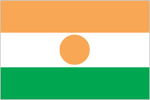 With its 17,466,172 people, Niger is the
62nd largest country in the world by
population. It is the 22nd largest country in the
world by area with 1,267,000 square kilometers.
With its 17,466,172 people, Niger is the
62nd largest country in the world by
population. It is the 22nd largest country in the
world by area with 1,267,000 square kilometers.
Niger became independent from France in 1960 and experienced single-party and military rule until 1991, when Gen. Ali SAIBOU was forced by public pressure to allow multiparty elections, which resulted in a democratic government in 1993. Political infighting brought the government to a standstill and in 1996 led to a coup by Col. Ibrahim BARE. In 1999, BARE was killed in a counter coup by military officers who restored democratic rule and held elections that brought Mamadou TANDJA to power in December of that year. TANDJA was reelected in 2004 and in 2009 spearheaded a constitutional amendment that would allow him to extend his term as president. In February 2010, a military coup deposed TANDJA, immediately suspended the constitution, and dissolved the Cabinet. ISSOUFOU Mahamadou emerged victorious from a crowded field in the election following the coup and was inaugurated in April 2011. Niger is one of the poorest countries in the world with minimal government services and insufficient funds to develop its resource base. The largely agrarian and subsistence-based economy is frequently disrupted by extended droughts common to the Sahel region of Africa. The Nigerien Movement for Justice, a predominantly ethnic Tuareg rebel group, emerged in February 2007, and attacked several military targets in Niger's northern region throughout 2007 and 2008. Successful government offensives in 2009 ended the rebellion. Niger is facing increased security concerns on its borders from various external threats including insecurity in Libya, spillover from the conflict in Mali, and violent extremism in northeastern Nigeria.
Check out the recommended reading list below for great sources of information on Niger