Compare
French Polynesia
to
Moldovato
MoldovaMoldova has an unemployment rate of 6.20% while French Polynesia has 21.80%
This entry contains the percent of the labor force that is without jobs.
Source:
CIA World Factbook
The life expectancy at birth in Moldova is 70.12 while in French Polynesia it is 76.79.
This entry contains the average number of years to be lived by a group of people born in the same year, if mortality at each age remains constant in the future. The entry includes total population as well as the male and female components. Life expectancy at birth is also a measure of overall quality of life in a country and summarizes the mortality at all ages. It can also be thought of as indicating the potential return on investment in human capital and is necessary for the calculation of various actuarial measures.
Source:
CIA World Factbook
5.00 in every 100,000 people are murdered annually in Moldova compared to 0.40 in French Polynesia
This entry contains the number of victims of an unlawful death purposefully inflicted on a person by another person. Data is originally sourced from either criminal justice or public health systems.
Source:
United Nations Office on Drugs and Crime
The GDP per capita in Moldova is $3,800 while in French Polynesia it is $22,000
This entry shows GDP on a purchasing power parity basis divided by population as of 1 July for the same year. A nation's GDP at purchasing power parity (PPP) exchange rates is the sum value of all goods and services produced in the country valued at prices prevailing in the United States. This is the measure most economists prefer when looking at per-capita welfare and when comparing living conditions or use of resources across countries. The measure is difficult to compute, as a US dollar value has to be assigned to all goods and services in the country regardless of whether these goods and services have a direct equivalent in the United States (for example, the value of an ox-cart or non-US military equipment); as a result, PPP estimates for some countries are based on a small and sometimes different set of goods and services. In addition, many countries do not formally participate in the World Bank's PPP project that calculates these measures, so the resulting GDP estimates for these countries may lack precision. For many developing countries, PPP-based GDP measures are multiples of the official exchange rate (OER) measure. The differences between the OER- and PPP-denominated GDP values for most of the wealthy industrialized countries are generally much smaller.
Source:
CIA World Factbook
The number of deaths of infants under one year old in a given year per 1,000 live births in Moldova is 12.93 while in French Polynesia it is 4.78.
This entry gives the number of deaths of infants under one year old in a given year per 1,000 live births in the same year; included is the total death rate, and deaths by sex, male and female. This rate is often used as an indicator of the level of health in a country.
Source:
CIA World Factbook
French Polynesia consumes 1.2012 gallons of oil per day per capita while Moldova consumes 0.1806
This entry is the total oil consumed in gallons per day (gal/day) divided by the population. The discrepancy between the amount of oil produced and/or imported and the amount consumed and/or exported is due to the omission of stock changes, refinery gains, and other complicating factors.
Source:
CIA World Factbook
The per capita consumption of electricity in French Polynesia is 2,231kWh while in Moldova it is 1,175kWh
This entry consists of total electricity generated annually plus imports and minus exports, expressed in kilowatt-hours. The discrepancy between the amount of electricity generated and/or imported and the amount consumed and/or exported is accounted for as loss in transmission and distribution.
Source:
CIA World Factbook
206 in every 100,000 people are currently imprisoned in Moldova compared to 158 in French Polynesia
This entry contains the number of people in penal institutions, including pre-trial detainees. Comparability is hampered by differences in local practice, including whether psychiatrically ill offenders are under the authority of the prison administration. People held in a form of custody not under the authority of a prison administration are not included in this figure.
Source:
International Centre for Prison Studies
The annual number of births per 1,000 people in Moldova is 12.21 while in French Polynesia it is 15.47.
This entry gives the average annual number of births during a year per 1,000 persons in the population at midyear; also known as crude birth rate. The birth rate is usually the dominant factor in determining the rate of population growth. It depends on both the level of fertility and the age structure of the population.
Source:
CIA World Factbook
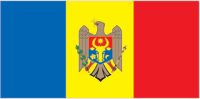 With its 3,583,288 people, Moldova is the
131st largest country in the world by
population. It is the 138th largest country in the
world by area with 33,851 square kilometers.
With its 3,583,288 people, Moldova is the
131st largest country in the world by
population. It is the 138th largest country in the
world by area with 33,851 square kilometers.
Part of Romania during the interwar period, Moldova was incorporated into the Soviet Union at the close of World War II. Although the country has been independent from the USSR since 1991, Russian forces have remained on Moldovan territory east of the Nistru River supporting the separatist region of Transnistria, composed of a Slavic majority population (mostly Ukrainians and Russians), but with a sizeable ethnic Moldovan minority. One of the poorest nations in Europe, Moldova became the first former Soviet state to elect a communist, Vladimir VORONIN, as its president in 2001. VORONIN served as Moldova's president until he resigned in September 2009, following the opposition's gain of a narrow majority in July parliamentary elections and the Communist Party's (PCRM) subsequent inability to attract the three-fifths of parliamentary votes required to elect a president and, by doing so, put into place a permanent government. Four Moldovan opposition parties formed a new coalition, the Alliance for European Integration (AEI), iterations of which have acted as Moldova's governing coalitions since. Moldova experienced significant political uncertainty between 2009 and early 2012, holding three general elections and numerous presidential ballots in parliament, all of which failed to secure a president. Following November 2010 parliamentary elections, a reconstituted AEI-coalition consisting of three of the four original AEI parties formed a government, and in March 2012 was finally able to elect an independent as president. As of late May 2013, the ruling coalition - comprised of two of the original AEI parties and a splinter group from a third - is called the Pro-European Coalition. In November 2013, the Moldovan Government initialed an Association Agreement with the European Union (EU), advancing the coalition's policy priority of EU integration.
Check out the recommended reading list below for great sources of information on Moldova