Compare
St. Martin
to
Libyato
LibyaLibya has an unemployment rate of 30.00% while St. Martin has 12.00%
This entry contains the percent of the labor force that is without jobs.
Source:
CIA World Factbook
The GDP per capita in Libya is $11,300 while in St. Martin it is $15,400
This entry shows GDP on a purchasing power parity basis divided by population as of 1 July for the same year. A nation's GDP at purchasing power parity (PPP) exchange rates is the sum value of all goods and services produced in the country valued at prices prevailing in the United States. This is the measure most economists prefer when looking at per-capita welfare and when comparing living conditions or use of resources across countries. The measure is difficult to compute, as a US dollar value has to be assigned to all goods and services in the country regardless of whether these goods and services have a direct equivalent in the United States (for example, the value of an ox-cart or non-US military equipment); as a result, PPP estimates for some countries are based on a small and sometimes different set of goods and services. In addition, many countries do not formally participate in the World Bank's PPP project that calculates these measures, so the resulting GDP estimates for these countries may lack precision. For many developing countries, PPP-based GDP measures are multiples of the official exchange rate (OER) measure. The differences between the OER- and PPP-denominated GDP values for most of the wealthy industrialized countries are generally much smaller.
Source:
CIA World Factbook
99 in every 100,000 people are currently imprisoned in Libya compared to 396 in St. Martin
This entry contains the number of people in penal institutions, including pre-trial detainees. Comparability is hampered by differences in local practice, including whether psychiatrically ill offenders are under the authority of the prison administration. People held in a form of custody not under the authority of a prison administration are not included in this figure.
Source:
International Centre for Prison Studies
The number of deaths of infants under one year old in a given year per 1,000 live births in Libya is 11.87 while in St. Martin it is 9.05.
This entry gives the number of deaths of infants under one year old in a given year per 1,000 live births in the same year; included is the total death rate, and deaths by sex, male and female. This rate is often used as an indicator of the level of health in a country.
Source:
CIA World Factbook
The life expectancy at birth in Libya is 76.04 while in St. Martin it is 77.61.
This entry contains the average number of years to be lived by a group of people born in the same year, if mortality at each age remains constant in the future. The entry includes total population as well as the male and female components. Life expectancy at birth is also a measure of overall quality of life in a country and summarizes the mortality at all ages. It can also be thought of as indicating the potential return on investment in human capital and is necessary for the calculation of various actuarial measures.
Source:
CIA World Factbook
The annual number of births per 1,000 people in Libya is 18.40 while in St. Martin it is 13.00.
This entry gives the average annual number of births during a year per 1,000 persons in the population at midyear; also known as crude birth rate. The birth rate is usually the dominant factor in determining the rate of population growth. It depends on both the level of fertility and the age structure of the population.
Source:
CIA World Factbook
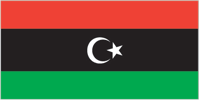 With its 6,244,174 people, Libya is the
107th largest country in the world by
population. It is the 17th largest country in the
world by area with 1,759,540 square kilometers.
With its 6,244,174 people, Libya is the
107th largest country in the world by
population. It is the 17th largest country in the
world by area with 1,759,540 square kilometers.
The Italians supplanted the Ottoman Turks in the area around Tripoli in 1911 and did not relinquish their hold until 1943 when defeated in World War II. Libya then passed to UN administration and achieved independence in 1951. Following a 1969 military coup, Col. Muammar al-QADHAFI assumed leadership and began to espouse his political system at home, which was a combination of socialism and Islam. During the 1970s, QADHAFI used oil revenues to promote his ideology outside Libya, supporting subversive and terrorist activities that included the downing of two airliners - one over Scotland, another in Northern Africa - and a discotheque bombing in Berlin. UN sanctions in 1992 isolated QADHAFI politically and economically following the attacks; sanctions were lifted in 2003 following Libyan acceptance of responsibility for the bombings and agreement to claimant compensation. QADHAFI also agreed to end Libya's program to develop weapons of mass destruction, and he made significant strides in normalizing relations with Western nations. Unrest that began in several Middle Eastern and North African countries in late 2010 erupted in Libyan cities in early 2011. QADHAFI's brutal crackdown on protesters spawned a civil war that triggered UN authorization of air and naval intervention by the international community. After months of seesaw fighting between government and opposition forces, the QADHAFI regime was toppled in mid-2011 and replaced by a transitional government. Libya in 2012 formed a new parliament and elected a new prime minister.
Check out the recommended reading list below for great sources of information on Libya