Compare
Monaco
to
Bhutanto
BhutanThe life expectancy at birth in Bhutan is 68.98 while in Monaco it is 89.57.
This entry contains the average number of years to be lived by a group of people born in the same year, if mortality at each age remains constant in the future. The entry includes total population as well as the male and female components. Life expectancy at birth is also a measure of overall quality of life in a country and summarizes the mortality at all ages. It can also be thought of as indicating the potential return on investment in human capital and is necessary for the calculation of various actuarial measures.
Source:
CIA World Factbook
The number of deaths of infants under one year old in a given year per 1,000 live births in Bhutan is 37.89 while in Monaco it is 1.81.
This entry gives the number of deaths of infants under one year old in a given year per 1,000 live births in the same year; included is the total death rate, and deaths by sex, male and female. This rate is often used as an indicator of the level of health in a country.
Source:
CIA World Factbook
Bhutan has an unemployment rate of 3.20% while Monaco has 2.00%
This entry contains the percent of the labor force that is without jobs.
Source:
CIA World Factbook
The GDP per capita in Bhutan is $7,000 while in Monaco it is $85,500
This entry shows GDP on a purchasing power parity basis divided by population as of 1 July for the same year. A nation's GDP at purchasing power parity (PPP) exchange rates is the sum value of all goods and services produced in the country valued at prices prevailing in the United States. This is the measure most economists prefer when looking at per-capita welfare and when comparing living conditions or use of resources across countries. The measure is difficult to compute, as a US dollar value has to be assigned to all goods and services in the country regardless of whether these goods and services have a direct equivalent in the United States (for example, the value of an ox-cart or non-US military equipment); as a result, PPP estimates for some countries are based on a small and sometimes different set of goods and services. In addition, many countries do not formally participate in the World Bank's PPP project that calculates these measures, so the resulting GDP estimates for these countries may lack precision. For many developing countries, PPP-based GDP measures are multiples of the official exchange rate (OER) measure. The differences between the OER- and PPP-denominated GDP values for most of the wealthy industrialized countries are generally much smaller.
Source:
CIA World Factbook
143 in every 100,000 people are currently imprisoned in Bhutan compared to 62 in Monaco
This entry contains the number of people in penal institutions, including pre-trial detainees. Comparability is hampered by differences in local practice, including whether psychiatrically ill offenders are under the authority of the prison administration. People held in a form of custody not under the authority of a prison administration are not included in this figure.
Source:
International Centre for Prison Studies
Per capita public and private health expenditures combined in Bhutan are $90.50 USD while Monaco spends $6,708.30 USD
This entry contains the per capita public and private health expenditure at purchase power parity using US Dollars. This figure combines government, personal, and employer spending on health care
Source:
World Health Organization
The annual number of births per 1,000 people in Bhutan is 18.12 while in Monaco it is 6.72.
This entry gives the average annual number of births during a year per 1,000 persons in the population at midyear; also known as crude birth rate. The birth rate is usually the dominant factor in determining the rate of population growth. It depends on both the level of fertility and the age structure of the population.
Source:
CIA World Factbook
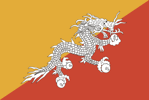 With its 733,643 people, Bhutan is the
163rd largest country in the world by
population. It is the 135th largest country in the
world by area with 38,394 square kilometers.
With its 733,643 people, Bhutan is the
163rd largest country in the world by
population. It is the 135th largest country in the
world by area with 38,394 square kilometers.
In 1865, Britain and Bhutan signed the Treaty of Sinchulu, under which Bhutan would receive an annual subsidy in exchange for ceding some border land to British India. Under British influence, a monarchy was set up in 1907; three years later, a treaty was signed whereby the British agreed not to interfere in Bhutanese internal affairs, and Bhutan allowed Britain to direct its foreign affairs. This role was assumed by independent India after 1947. Two years later, a formal Indo-Bhutanese accord returned to Bhutan the areas annexed by the British, formalized the annual subsidies the country received, and defined India's responsibilities in defense and foreign relations. In March 2005, King Jigme Singye WANGCHUCK unveiled the government's draft constitution - which introduced major democratic reforms - and pledged to hold a national referendum for its approval. In December 2006, the King abdicated the throne in favor of his son, Jigme Khesar Namgyel WANGCHUCK, in order to give him experience as head of state before the democratic transition. In early 2007, India and Bhutan renegotiated their treaty, eliminating the clause that stated that Bhutan would be "guided by" India in conducting its foreign policy, although Thimphu continues to coordinate closely with New Delhi. Elections for seating the country's first parliament were completed in March 2008; the king ratified the country's first constitution in July 2008. Bhutan experienced a peaceful turnover of power following parliamentary elections in 2013, which routed the incumbent party. The disposition of some 30,000 Bhutanese refugees - housed in two UN refugee camps in Nepal - remains unresolved.
Check out the recommended reading list below for great sources of information on Bhutan