Compare
Gabon
to
Saudi Arabiato
Saudi ArabiaThe life expectancy at birth in Saudi Arabia is 74.82 while in Gabon it is 52.06.
This entry contains the average number of years to be lived by a group of people born in the same year, if mortality at each age remains constant in the future. The entry includes total population as well as the male and female components. Life expectancy at birth is also a measure of overall quality of life in a country and summarizes the mortality at all ages. It can also be thought of as indicating the potential return on investment in human capital and is necessary for the calculation of various actuarial measures.
Source:
CIA World Factbook
Gabon consumes 0.3948 gallons of oil per day per capita while Saudi Arabia consumes 4.3260
This entry is the total oil consumed in gallons per day (gal/day) divided by the population. The discrepancy between the amount of oil produced and/or imported and the amount consumed and/or exported is due to the omission of stock changes, refinery gains, and other complicating factors.
Source:
CIA World Factbook
The per capita consumption of electricity in Gabon is 862kWh while in Saudi Arabia it is 6,980kWh
This entry consists of total electricity generated annually plus imports and minus exports, expressed in kilowatt-hours. The discrepancy between the amount of electricity generated and/or imported and the amount consumed and/or exported is accounted for as loss in transmission and distribution.
Source:
CIA World Factbook
Saudi Arabia has an unemployment rate of 11.60% while Gabon has 21.00%
This entry contains the percent of the labor force that is without jobs.
Source:
CIA World Factbook
The number of deaths of infants under one year old in a given year per 1,000 live births in Saudi Arabia is 14.58 while in Gabon it is 47.03.
This entry gives the number of deaths of infants under one year old in a given year per 1,000 live births in the same year; included is the total death rate, and deaths by sex, male and female. This rate is often used as an indicator of the level of health in a country.
Source:
CIA World Factbook
The GDP per capita in Saudi Arabia is $31,300 while in Gabon it is $19,200
This entry shows GDP on a purchasing power parity basis divided by population as of 1 July for the same year. A nation's GDP at purchasing power parity (PPP) exchange rates is the sum value of all goods and services produced in the country valued at prices prevailing in the United States. This is the measure most economists prefer when looking at per-capita welfare and when comparing living conditions or use of resources across countries. The measure is difficult to compute, as a US dollar value has to be assigned to all goods and services in the country regardless of whether these goods and services have a direct equivalent in the United States (for example, the value of an ox-cart or non-US military equipment); as a result, PPP estimates for some countries are based on a small and sometimes different set of goods and services. In addition, many countries do not formally participate in the World Bank's PPP project that calculates these measures, so the resulting GDP estimates for these countries may lack precision. For many developing countries, PPP-based GDP measures are multiples of the official exchange rate (OER) measure. The differences between the OER- and PPP-denominated GDP values for most of the wealthy industrialized countries are generally much smaller.
Source:
CIA World Factbook
Per capita public and private health expenditures combined in Saudi Arabia are $795.10 USD while Gabon spends $396.70 USD
This entry contains the per capita public and private health expenditure at purchase power parity using US Dollars. This figure combines government, personal, and employer spending on health care
Source:
World Health Organization
The percentage of adults living with HIV/AIDS in Saudi Arabia is 0.01% while in Gabon it is 4.00%.
This entry gives an estimate of the percentage of adults (aged 15-49) living with HIV/AIDS. The adult prevalence rate is calculated by dividing the estimated number of adults living with HIV/AIDS at yearend by the total adult population at yearend.
Source:
CIA World Factbook
161 in every 100,000 people are currently imprisoned in Saudi Arabia compared to 210 in Gabon
This entry contains the number of people in penal institutions, including pre-trial detainees. Comparability is hampered by differences in local practice, including whether psychiatrically ill offenders are under the authority of the prison administration. People held in a form of custody not under the authority of a prison administration are not included in this figure.
Source:
International Centre for Prison Studies
6.20 in every 100,000 people are murdered annually in Saudi Arabia compared to 9.40 in Gabon
This entry contains the number of victims of an unlawful death purposefully inflicted on a person by another person. Data is originally sourced from either criminal justice or public health systems.
Source:
United Nations Office on Drugs and Crime
The annual number of births per 1,000 people in Saudi Arabia is 18.78 while in Gabon it is 34.64.
This entry gives the average annual number of births during a year per 1,000 persons in the population at midyear; also known as crude birth rate. The birth rate is usually the dominant factor in determining the rate of population growth. It depends on both the level of fertility and the age structure of the population.
Source:
CIA World Factbook
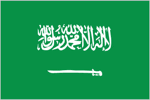 With its 27,345,986 people, Saudi Arabia is the
46th largest country in the world by
population. It is the 13th largest country in the
world by area with 2,149,690 square kilometers.
With its 27,345,986 people, Saudi Arabia is the
46th largest country in the world by
population. It is the 13th largest country in the
world by area with 2,149,690 square kilometers.
Saudi Arabia is the birthplace of Islam and home to Islam's two holiest shrines in Mecca and Medina. The king's official title is the Custodian of the Two Holy Mosques. The modern Saudi state was founded in 1932 by ABD AL-AZIZ bin Abd al-Rahman Al SAUD (Ibn Saud) after a 30-year campaign to unify most of the Arabian Peninsula. One of his male descendants rules the country today, as required by the country's 1992 Basic Law. King ABDALLAH bin Abd al-Aziz ascended to the throne in 2005. Following Iraq's invasion of Kuwait in 1990, Saudi Arabia accepted the Kuwaiti royal family and 400,000 refugees while allowing Western and Arab troops to deploy on its soil for the liberation of Kuwait the following year. The continuing presence of foreign troops on Saudi soil after the liberation of Kuwait became a source of tension between the royal family and the public until all operational US troops left the country in 2003. Major terrorist attacks in May and November 2003 spurred a strong on-going campaign against domestic terrorism and extremism. King ABDALLAH since 2005 has worked to incrementally modernize the Kingdom - driven by personal ideology and political pragmatism - through a series of social and economic initiatives, including expanding employment and social opportunities for women, attracting foreign investment, increasing the role of the private sector in the economy, and discouraging businesses from hiring foreign workers. The Arab Spring inspired protests - increasing in number since 2011 but usually small in size - over primarily domestic issues among Saudi Arabia's majority Sunni population. Riyadh has taken a cautious but firm approach by arresting some protesters but releasing most of them quickly, and by using its state-sponsored clerics to counter political and Islamist activism. In addition, Saudi Arabia has seen protests among the Shia populace in the Eastern Province, who have protested primarily against the detention of political prisoners, endemic discrimination, and Bahraini and Saudi Government actions in Bahrain. Protests are met by a strong police presence, with some arrests, but not the level of bloodshed seen in protests elsewhere in the region. In response to the unrest, King ABDALLAH in February and March 2011 announced a series of benefits to Saudi citizens including funds to build affordable housing, salary increases for government workers, and unemployment entitlements. To promote increased political participation, the government held elections nationwide in September 2011 for half the members of 285 municipal councils - a body that holds little influence in the Saudi Government. Also in September, the king announced that women will be allowed to run for and vote in future municipal elections - first held in 2005 - and serve as full members of the advisory Consultative Council. The country remains a leading producer of oil and natural gas and holds about 17% of the world's proven oil reserves. The government continues to pursue economic reform and diversification, particularly since Saudi Arabia's accession to the WTO in 2005, and promotes foreign investment in the kingdom. A burgeoning population, aquifer depletion, and an economy largely dependent on petroleum output and prices are ongoing governmental concerns.
Check out the recommended reading list below for great sources of information on Saudi Arabia