Compare
Falkland Islands
to
Mexicoto
MexicoThe GDP per capita in Mexico is $15,600 while in Falkland Islands it is $55,400
This entry shows GDP on a purchasing power parity basis divided by population as of 1 July for the same year. A nation's GDP at purchasing power parity (PPP) exchange rates is the sum value of all goods and services produced in the country valued at prices prevailing in the United States. This is the measure most economists prefer when looking at per-capita welfare and when comparing living conditions or use of resources across countries. The measure is difficult to compute, as a US dollar value has to be assigned to all goods and services in the country regardless of whether these goods and services have a direct equivalent in the United States (for example, the value of an ox-cart or non-US military equipment); as a result, PPP estimates for some countries are based on a small and sometimes different set of goods and services. In addition, many countries do not formally participate in the World Bank's PPP project that calculates these measures, so the resulting GDP estimates for these countries may lack precision. For many developing countries, PPP-based GDP measures are multiples of the official exchange rate (OER) measure. The differences between the OER- and PPP-denominated GDP values for most of the wealthy industrialized countries are generally much smaller.
Source:
CIA World Factbook
Mexico has an unemployment rate of 4.80% while Falkland Islands has 4.10%
This entry contains the percent of the labor force that is without jobs.
Source:
CIA World Factbook
Falkland Islands consumes 4.4352 gallons of oil per day per capita while Mexico consumes 0.7434
This entry is the total oil consumed in gallons per day (gal/day) divided by the population. The discrepancy between the amount of oil produced and/or imported and the amount consumed and/or exported is due to the omission of stock changes, refinery gains, and other complicating factors.
Source:
CIA World Factbook
The per capita consumption of electricity in Falkland Islands is 6,221kWh while in Mexico it is 1,764kWh
This entry consists of total electricity generated annually plus imports and minus exports, expressed in kilowatt-hours. The discrepancy between the amount of electricity generated and/or imported and the amount consumed and/or exported is accounted for as loss in transmission and distribution.
Source:
CIA World Factbook
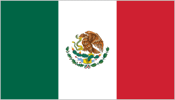 With its 120,286,655 people, Mexico is the
11th largest country in the world by
population. It is the 14th largest country in the
world by area with 1,964,375 square kilometers.
With its 120,286,655 people, Mexico is the
11th largest country in the world by
population. It is the 14th largest country in the
world by area with 1,964,375 square kilometers.
The site of several advanced Amerindian civilizations - including the Olmec, Toltec, Teotihuacan, Zapotec, Maya, and Aztec - Mexico was conquered and colonized by Spain in the early 16th century. Administered as the Viceroyalty of New Spain for three centuries, it achieved its independence early in the 19th century. The global financial crisis beginning in late 2008 caused a massive economic downturn the following year, although growth returned quickly in 2010. Ongoing economic and social concerns include low real wages, underemployment for a large segment of the population, inequitable income distribution, and few advancement opportunities for the largely indigenous population in the impoverished southern states. The elections held in 2000 marked the first time since the 1910 Mexican Revolution that an opposition candidate - Vicente FOX of the National Action Party (PAN) - defeated the party in government, the Institutional Revolutionary Party (PRI). He was succeeded in 2006 by another PAN candidate Felipe CALDERON, but Enrique PENA NIETO regained the presidency for the PRI in 2012. Since 2007, Mexico's powerful drug-trafficking organizations have engaged in bloody feuding, resulting in tens of thousands of drug-related homicides.
Check out the recommended reading list below for great sources of information on Mexico